News, Featured
News, Featured
News, Featured
Meet a Scientist: Claire Puleio
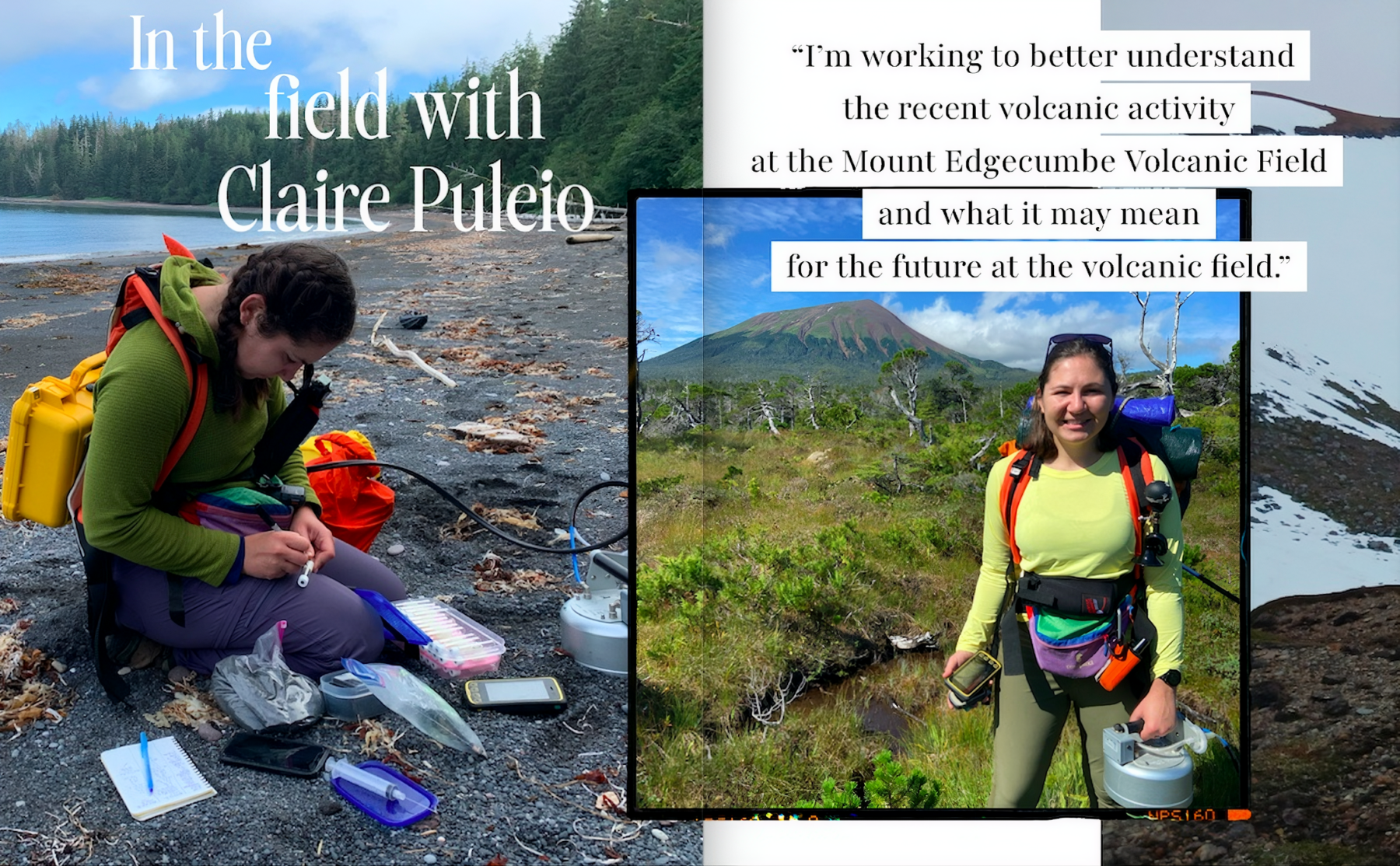
Our work focuses on the lands and waters of Sitka Sound—but it brings together researchers, educators, and scientists from across the country. Their unique perspectives and expertise all combine with that of our staff and local partners to help deepen our understanding of Southeast Alaska’s complex environments.Throughout the year, we are lucky to welcome a variety of external researchers and collaborators to Sitka. Each individual contributes a unique lens—whether they’re working on marine ecosystems, climate change, fisheries, coastal resilience, or much more—while contributing to research that resonates far beyond our region.Claire Puleio studies Mount Edgecumbe at UAF where her research combines gas geochemistry, remote sensing, computer modelling, petrology, and laboratory experiments to investigate the volcano’s past eruptions and recent unrest. She earned her Bachelor of Science in Geology from Union College in upstate New York and her Master of Science in Geology from Washington State University. She is currently pursuing her PhD in Geoscience at UAF, and recently spent time in Sitka as a Science in Residency Fellow!
Describe your research objectives?I’m working to better understand the recent volcanic activity at the Mount Edgecumbe Volcanic Field and what it may mean for the future at the volcanic field. I am doing this by measuring any gas and heat emitted from the surface of the volcano to gain a better understanding of current activity and by studying past activity at the volcano that led to explosive eruptions through lab work. All of this information will give us further insight into what we may expect from the volcanic field in the future.
What does your field work look like when you come to Sitka as a visiting researcher?
In the past I have spent time on Kruzof island measuring gas and heat emitted from the surface of the volcanic field to determine if these emissions are volcanic in origin. As a SIRF, I spent time interacting with the community to share what I have learned about their volcano and learn from community members about what they know. I also spent time writing up my lab work findings for a manuscript that will be submitted soon.
How does working in Sitka broaden your research?Working in Sitka and with SSSC has allowed me to connect with those who would be most impacted by any volcanic activity at the Mount Edgecumbe Volcanic Field. SSSC has facilitated these interactions and allowed me to spend time with a wide variety of the public.
How do you engage with the local community here in Sitka while conducting field work in their home?Through the connections facilitated by SSSC, I have been able to share with the local community my approach to the questions I am trying to answer, exactly what I did to answer them, and how I interpret my results. I think it’s not just important to share your results, but the entire process. I was able to do this by engaging in the community through a Natural History Seminar, a radio interview and nature show, SSSC Scientists in the Schools program with 10th graders, individual dinners and visits with community members, and much more!
Why should communities (whether in CA, AK or elsewhere) pay attention to your research?Volcanoes are all around the world! The information we gain from studying one volcano helps to gain a better understanding of all volcanoes, which allows us to continue living near and interacting with volcanoes in a safe way.