SIRF, Landslide Research, News, Research, Featured
SIRF, Landslide Research, News, Research, Featured
SIRF, Landslide Research, News, Research, Featured
Meet a Scientist: Ries Plescher
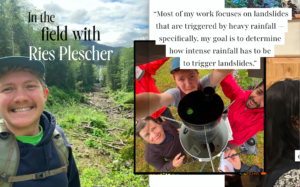
Our work focuses on the lands and waters of Sitka Sound—but it brings together researchers, educators, and scientists from across the country. Their unique perspectives and expertise all combine with that of our staff and local partners to help deepen our understanding of Southeast Alaska’s complex environments.Throughout the year, we are lucky to welcome a variety of external researchers and collaborators to Sitka. Each individual contributes a unique lens—whether they’re working on marine ecosystems, climate change, fisheries, coastal resilience, or much more—while contributing to research that resonates far beyond our region.Ries Plescher is a PhD Candidate at the University of Oregon’s Earth Surface Processes Lab. He has spent the past two years working with the Science Center’s Geohazards Research team on the Ḵutí project, an initiative aimed at developing tools to mitigate risks associated with precipitation-induced hazards such as landslides and floods in Southeast Alaska. He is currently spending time in Sitka as a Science in Residency Fellow, and will be hosting many public events while here — make sure to stop by and ask him all about landslides!
Describe your research objectives?For the past two years I’ve been involved with the Ḵutí project, a tribally led effort to reduce the hazard of landslides. Most of my work focuses on landslides that are triggered by heavy rainfall —specifically, my goal is to determine how intense rainfall has to be to trigger landslides. These rainfall “thresholds” can be made into tools that communicate landslide risk based on forecasted rainfall. This is not an exact science — I spend most of my time in the field talking with people in Southeast so that I can better understand what tools are helpful, and what local knowledge can help improve them.
What does your field work look like when you come to Sitka as a visiting researcher?
So, a lot of my work here is hoping to do exactly that — talk, answer questions, but mostly listen to peoples lived experiences with heavy rainfall and landslides. When I get the chance, I hope to take a look at rainfall that has been recorded by local rain gauges on Gavan ridge and Harbor Mountain, in order to better understand how much precipitation varies from place to place in Sitka.
How does working in Sitka broaden your research?The staff at SSSC have a wealth of knowledge about community-driven research, and I’ve learned so much about how I can be a more engaged researcher from them. Working each day with them and co-developing outreach activities broadens and strengthens my skills as a scientific communicator and as a collaborator.
How do you engage with the local community here in Sitka while conducting field work in their home?I’ll be hosting several public workshops, talks, informal office hours, and Q&A sessions while I’m here to spur conversations about landslides! Besides that, I’m really excited to participate as fully as I can in community events such as Alaska Day, Halloween, and WhaleFest!
Why should communities (whether in OR, AK or elsewhere) pay attention to your research?While each community in Southeast has a unique combination of culture, history, and geologic hazard, the tools that we build are meant to be easily adaptable across regions and landscapes. We are expanding this research to all communities that reach out and express interest in building similar protective tools for their corner of the coast.
