Sitka WhaleFest, News, Events, Featured
Sitka WhaleFest, News, Events, Featured
Sitka WhaleFest, News, Events, Featured
Sitka WhaleFest Generations of Giants
The 30th Annual Sitka WhaleFest will be
November 5th – 9th, 2026
This year’s theme is Generations of Giants: 30 Years of Whales, Wisdom, and What Follows.
Join us to celebrate three decades of Sitka WhaleFest, the people that shaped it, and the next generation.
About WhaleFest
Sitka WhaleFest celebrates marine life through science, art, culture, and adventure. Attendees of all ages and backgrounds leave WhaleFest with a deeper connection to the ocean.
The core of Sitka WhaleFest is the three-day Science Symposium, where scientists and knowledge-bearers share the latest research and learning about marine life. This symposium is for everyone: speakers highlight the relevance and accessibility of their knowledge to people from all walks of life. Deepen your WhaleFest experience by participating in hands-on workshops, appreciating the work of artists and performers, exploring Sitka Sound, and engaging with Sitka’s vibrant community. This annual Sitka tradition is not to be missed!
Our featured artist this year is Mary Goddard.
See full schedule and sign up for special events at
SitkaWhaleFest.org
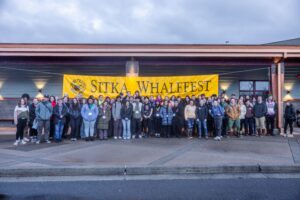
Science Symposium Speakers
The heart of Sitka WhaleFest is the three-day symposium, where world-renowned scientists share their current research. These presentations are unique because the speakers are chosen for their ability to communicate their work and engage a broad, sweeping audience. This innovative science event gives future scientists and anyone interested in our oceans opportunities to meet and interact with a passionate and diverse group of speakers. Each afternoon, symposium participants and guest speakers will explore a daily theme connected to the overall theme of the symposium.
Nov 6, Friday
12:45 Welcome & Opening Remarks
1:00 to 1:45 pm | Flip Nicklin | “Among Giants: A (photographer’s) life with whales” – My story of photographing whales and whale researchers for National Geographic Magazine. An improbable 50 year life with whales.
2:00 to 2:45 pm | Fred Sharpe | “Spouting Off: Airborne Sounds of the Humpback Whale” – How the unique geography and oceanography of Southeast Alaska’s fjords shape where whales occur, how they have used these dynamic habitats over time, and how these patterns may shift in the future.
3:00 to 3:45 pm | Hannah Clayton | “Reading Resilience: how new technologies are changing our understandings of whales”– Modern-day tools like drones, tags, and models are opening new windows into the lives of baleen whales, especially in changing climates. In this talk, Hannah introduces us to the Washington gray whale “Sounders” of northern Puget Sound, and what they can teach us about the resilience of the species.
Nov 7, Saturday
1:00 to 1:45 pm | John & Finn Straley | Friend, Mother, Icon: Growing Up with Jan Straley – Jan Straley began studying whales in 1979. Since then she has been devoted to her research and telling the stories of these mysterious creatures. She was in on the ground floor of Sitka WhaleFest. She has also been devoted to her colleagues, friends and family. In this talk her son, Finn, and husband, John, will tell the story of how this extraordinary woman became a preeminent field researcher working mostly out of small boats along the wild coastline of southeastern Alaska.
2:00 to 2:45 pm | Ted Cheeseman | “Humpback Whales are Remarkably Stubborn Home-Bodies” – The 2014-2016 marine heatwave killed one in three Hawaiian humpbacks. Why didn’t these long-distance migrants simply feed elsewhere? Ted shares what Happywhale’s ocean-wide citizen science reveals.
3:00 to 3:45 pm | Hannah Myers | “Marine Mammals and Fisheries: Interactions in a Changing Ocean” – Explore the evolving interactions between marine mammals and fisheries, and how the science behind these relationships might shape management practices in the future.
Nov 8, Sunday
1:00 to 1:45 pm | Vera Kingeekuk Metcalf | Nangaghneghput: Our Way of Life – The people of St. Lawrence Island remain closely interconnected with their homeland and waters, dependent on marine mammals, fish, and birds not only for their food security, but also for nourishing them culturally and spiritually, as they have been for millennia. Ms. Metcalf will share Indigenous Knowledge of the relationship with whales, walrus, and seals, her work in marine mammal co-management, and the importance of Indigenous voices in public policy and conservation.
Orlin Gologergen | From Risk to Resilience: Bridging Marine Mammal Research, Indigenous Knowledge, and Environmental Health– Mercury is a persistent environmental contaminant that accumulates in marine food webs and can pose health risks to people who rely on subsistence foods. Orlin’s project will measure mercury in subsistence foods harvested in Nome and Savoonga, examining differences among species, tissue types, harvest locations, and seasons. The work aims to support community priorities around food safety while integrating Western science and Indigenous Knowledge in community-driven contaminant research.
2:00 to 2:45 pm | Ed Lyman | “Unraveling Large Whale Entanglements”– The talk will dissect the impacts that large whale entanglements pose with a focus on “unraveling” what is a broad-based threat. The speaker will review the difficult and dangerous task of cutting large whales free (unraveling the animals), and the value of garnering information to better understand (unravel) the threat and thereby reduce it for the animals and humans alike. Examples through the use of novel and exciting imagery will be provided on the use of innovative technologies, modified fishing methods, and knowledge of the animals to unravel the challenges that large whale entanglement response poses.
3:00 to 3:45 pm | Mike Castellini | “Back to the Future: Whalefest and Beyond” – Over a career that carried him from Alaska to Antarctica, Mike Castellini has studied how marine mammals adapt to life in the sea, and mentored generations of students along the way. He has also helped shape the Sitka WhaleFest symposium since 1999, identifying and inviting the scientists who have filled this stage for more than 25 years. In this closing talk, he draws together what we have heard across the weekend, tracing how decades of discovery and conversation brought us here, and where they are taking us next.
See full schedule and sign up for special events at
